Here's your final roundup with the Acting and Directing categories and my feelings on the Best Picture Nominees. In case you missed the previous portions, click through to see Part One, Part Two, plus rundowns of the Animated Shorts, Live Action Shorts, Documentary Shorts, and Documentary Features.
This year I managed to see 43 out of the 52 total features and shorts honored by the Academy, meaning I can attest to having seen 113 of the 122 nominees (Over 90%, bam!) To make things easier, here are the nine films I missed, with nary an expected winner in the bunch:
- Four of the Five Foreign Language Films (No, A Royal Affair, Kon-Tiki, War Witch)
- One of the Feature Docs (The Gatekeepers)
- One Animated Feature (The Pirates! Band of Misfits - actually, I did catch the last 30 minutes)
- One with an Original Song Nominee (Chasing Ice)
- One Costume nominee (Mirror, Mirror - It was on Netflix Instant, but...meh. Ok, this is a possible winner, and would be a posthumous win for designer Eiko Ishioka.)
- One Best Actress nominee (The Impossible. It was here and gone in an instant, which meant catching this wave was basically...what's the word? Ah yes. Impracticable.)
Onward:
Best Performance by an Actress in a Supporting Role
Nominees:
- Amy Adams - The Master
- Sally Field - Lincoln
- Anne Hathaway - Les Misérables
- Helen Hunt - The Sessions
- Jacki Weaver - Silver Linings Playbook
Mr. Weinstein draws a lot of water in Hollywood to get
Silver Linings Playbook a clean sweep of top nominees, but Weaver is probably here only because of that. The rest of the ladies were memorable, though Hunt's role amounts to more of a lead. She definitely deserves kudos for a strong, revealing comeback, but it's a shame John Hawkes got snubbed, leaving her with the only nomination in a brave, expressive, forward-thinking film. Adams exudes a quiet power in
The Master, and I hope she sinks her teeth into more roles like this as opposed to the banal trap of romantic comedies. What's that? She's playing
Janis Joplin? Well, so much for
quiet power.
 |
| ...and then Mrs. Lincoln was all, "Eat a sandwich." |
That said, depending on the ebb and flow of the voters' feelings on
Lincoln, there is an
outside chance that Sally Field could steal this. Like Mad Max gulaged into the wastelands outside outside. Oh, that kooky Mary Todd, she was the Jeff to Abe's Mutt. The Tattoo to his Roarke. The unhinged pea to his stoic carrot. In case you haven't heard,
the Academy kinda likes her, and in any other year she would be a shoe-in. There are two problems this year, though: (1) Prostitutes always beat First Ladies; and (2) The Oscars are still trying to be "young and hip" despite so much evidence to the contrary. Anne Hathaway is a damn near holy lock to win for delivering perhaps the single most memorable scene of the year. If she tries to act surprised it had better be damned convincing, having just won an award attesting to her abilities in said profession.
Want/Will: Hathaway
Best Performance by an Actor in a Supporting Role
Nominees:
- Alan Arkin - Argo
- Robert De Niro - Silver Linings Playbook
- Philip Seymour Hoffman - The Master
- Tommy Lee Jones - Lincoln
- Christoph Waltz - Django Unchained
 I’ve heard and read a lot of buttering up about De Niro, and he can make whatever films he damn well pleases, thank you very much, but to me he’s been sliding perilously close to self-parody for a while now. Placing a Silver Linings Playbook statue between the Jake LaMotta award and the Young Vito Corleone award would be an easy way to get the new one whacked.
Arkin is a bit of an oddity here, as I felt he was outshone in virtually every scene by John Goodman. Tommy Lee Jones definitely put in some worthy work, however, heading up a simply spectacular supporting cast while spending "
the whole thing looking like an unmade bed," to borrow the words of Wesley Morris. (Great critic, by the way. Worth a read.)
Waltz steals the show in yet another ride along with QT, gobbling up nearly as much screen time as Jamie Foxx and what seems like double the dialogue. This is your prime annual example of the Academy misplacing a role. Hoffman, too, has enough heft in his to justify lead consideration -- he is, after all, The Master (cue Last Dragon theme) -- but his subtlety is buried by the Vesuvian deluge emitting from Joaquin Phoenix.
Want: Waltz
Will: Jones
Best Performance by an Actress in a Leading Role
Nominees:
- Jessica Chastain - Zero Dark Thirty
- Jennifer Lawrence - Silver Linings Playbook
- Emmanuelle Riva - Amour
- Quvenzhané Wallis - Beasts of the Southern Wild
- Naomi Watts - The Impossible
First thing's first, a performance by a six-year-old is
not winning an Oscar, no matter how frizzy her hair is, no matter how deliciously precocious and cute --
-- OMG!! SO ADORBS GIVE IT TO HER NOW!
Wait. Pull yourself together, man. Breathe. Composure. Logic. It's not happening. Right then.
Until recently a lot of the buildup for this has pitted Jessica Chastain and Jennifer Lawrence as the frontrunners. I was a fan of Chastain’s single-minded turn as CIA Agent Maya Lastnameredacted in Zero Dark Thirty, though it might have been a more powerfully tragic character if history hadn't intervened (favorably or unfavorably, depending on how you look at it). On the other hand, Jennifer Lawrence’s Tiffany loops through wide, indiscriminate swings that really didn’t add up to “mental instability” as much as “uneven character development,” also known as "bitch be trippin'." Thankfully, momentum is building for Emmanuelle Riva. I will have more to say about her bare, painstaking transformation in
Amour during the Best Picture discussion, but I'm taking Lawrence wins then Michael Haneke is right and there is no God. Yes, I understand that may be a self-defeating proclamation.
Want/Will: Riva.
Best Performance by an Actor in a Leading Role
Nominees:
- Bradley Cooper - Silver Linings Playbook
- Daniel Day-Lewis - Lincoln
- Hugh Jackman - Les Misérables
- Joaquin Phoenix - The Master
- Denzel Washington - Flight
Denzel flexes his actor muscle once again in a tolerable movie about alcoholism that is more likely to make you quit flying commercial than quit drinking. Apparently not enough people were convinced by
Ray Milland. (Now THAT made me put my beer down. Just for a minute, though.) Jackman is okay, but he's no Harry Baur. Cooper, I hate to say it, but he's pretty damn good. He
almost made me like him for the first time, and that's saying a lot. (Ok, I'm being a
bit hyperbolic, he was great in
Wet Hot American Summer.)
I’ve said it before and I'll say it again, Phoenix’s Freddie Quell is a raw, oozing volcano of method acting, on par with Jake LaMotta, or Stanley Kowalski. Paul Thomas Anderson’s piece was visionary but enigmatic, and a pickup for Phoenix could salvage what otherwise seems destined for cinema’s acclaimed-but-quickly-forgotten bin. Phoenix, for his part, couldn’t care less. Or could he? No. No, he couldn’t.
Daniel Day-Lewis is probably just as uninterested in “acting as competition,” he is just much more well-mannered about it. When all is said and done, though, he will go down as the arbitrarily-bestowed "greatest film actor of his generation,” except he will have the hardware to back it up, though it could be argued that he was better as Bill the Butcher than Abe the Law Talkin' Guy. If/when he wins he will be the first male actor to win three times for a lead role. (The incomparable Katharine Hepburn is just laaafffing from up above, clutching at the ghosts of her four best actress trophies.)
Want: Joaquin Phoenix
Will: Daniel Day-Lewis
Best Achievement in Directing
Nominees:
- Michael Haneke - Amour
- Ang Lee - Life of Pi
- David O. Russell - Silver Linings Playbook
- Steven Spielberg - Lincoln
- Behn Zeitlin - Beasts of the Southern Wild
A lot of controversy over the perceived snubs of Ben Affleck (
Argo) and Kathryn Bigelow (
Zero Dark Thirty), making the inclusion of Zeitlin a bit of an underdog surprise and Russell likely another piece of the Weinstein puzzle. Frankly, the wind could blow any which way on this, and we may be in for a relatively rare Best Director/Picture split. Haneke is my first choice, but may be having drinks with Joaquin Phoenix, expounding on the meaninglessness and vanity of it all. So I'm rooting for David, but expecting Goliath.
Want: Zeitlin
Will: Spielberg
Best Motion Picture of the Year
Nominees presented in reverse alphabetical order because it's more dramatic that way:
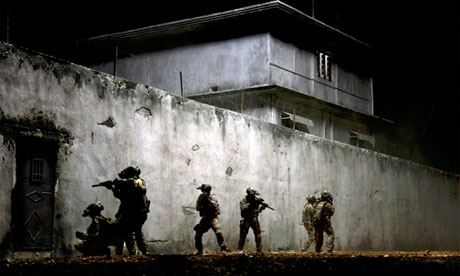
That people can't agree whether Bigelow's film endorses or abhors interrogative torture seems to say more about the people needing to justify their political positions than clarify the film stance, which I found intentionally ambivalent, trying instead to display the reality of the situation. It is much more relevant to view Zero Dark Thirty as a portrait of determined obsession, of a person and of a nation, shining a light on the collateral toll that has mounted along the way. It was also one of the most gripping thrillers of the year, all the more amazing since everyone on the planet already knew the outcome.

It should be clear by now that I was not exactly enamored with
SLP. This feeling may have stemmed from seeing the plot described via the
film's trailer and deciding (perhaps unfairly) that it was going to be an eye-rolling, cringeworthy shit sundae with a redemptive LET'S DANCE IT OUT! scene as the cherry on top. I will say that I was pleasantly pleased that it exceeded these base expectations, and it
is an aboverage romcom, good for some laughs. It is nice to see Chris Tucker back, serving his supporting role with restrained nervous energy. The rest of the cast is solid, but I'm just not seeing the Awards circuit darling. Don't get me started on the multiple Spirit wins last night for a thinly-veiled studio film that pushes through the
upper levels of the criteria.
It has problems, from weak and unbelievable plot points to its casual attitude toward mental illness. Mainly, though, the characters are just not very likable, which is a bit of a kiss of death for a feel-good love story, even one trying to be nutty and acerbic. I didn't really care whether or not Pat and Tiffany wind up together. (SPOILER: they totally complete each other!) It's a mess of a film made to look all too tidy. Given its subject matter, perhaps it's quite fitting that it's not all there.
It has every lofty credential behind it, all the polish on the script, beautiful to ear and eye. The company is top shelf and perfectly cast, with Daniel Day-Lewis a resolute figurehead and Sally Field his complement, with Tommy Lee Jones and James Spader among others pitching in with the heavy lifting and comic relief. Why, then, should the Academy pass it up this year for the big prize? Ultimately, I just think Spielberg is a supremely manipulative (and, yes, talented) director, and transparently so. Granted, film is inherently a medium of manipulation, but even when I agree with the agenda, Spielberg tends to go overboard. With him, they are rarely subtle manipulations, they are powerful -- let's face it, it's propaganda masquerading as a dramatization of history.
One of the most visually striking films of the year, but also one of the most frustrating. Ang Lee's fable takes us for a journey with the promise of an utterly meaningful experience. But while Pi's journey on its face is remarkable, the aimless jumble of "religious-ish" thematic trappings and the distracting, tiresome flashback construction leave the overarching work wanting for a soul. The ending muddies things up even more with Pi's puzzling reinterpretation of events, which strips away the metaphor and undermines much of the symbolism and deeper meaning.
Anecdotally, it definitely didn't help that the theater where I was screening it had a short power outage with about five minutes left in the film, leaving me and a crowd over 30 minutes to sit, think, and sort out what we'd seen before being able to see the conclusion that would hopefully tie everything together. What we got after that wait was, simply, "which story do you prefer?" Me? I would watch the images for hours, but storywise, I'd prefer a different one, thanks.
I've said my piece on the live singing experiment and how Tom Hooper's film doesn't quite hold a candlestick to other adaptations. Certainly a memorable experience with Hathaway delivering a wreckage of emotion that would have been nice to be able to dole out to some of the other characters, but overall it's unlikely to surpass the book or the original stage musical for cultural influence.

Not likely to take home much hardware this year outside a possible pickup by Waltz, but delicious performances by he, DiCaprio, and Sam Jackson are worth the price of admission. Tarantino is a film nerd's director, stuffing homages, references, and flat-out imitations into his own weird, reinvented world, always delivering his brand of love-it-or-leave-it humor and violence. And man, the dude knows how to rile people up. Spike Lee famously said he would never see
Django Unchained, denouncing its very premise as an exploitative revenge fantasy. He's right, it absolutely is, but it's damn fun to watch.
Leaving the race bit out of things for now, this film also fell into a year where gun ownership and acts of violence have been front-page mainstays. (How long until Seth McFarlane makes the crack about how tonight's Oscar is the one who
didn't shoot his girlfriend? Low-hanging fruit and way too soon? Yep and yep.) Violence is a part of film culture because violence is part of real life. One of the great things about the medium is that it allows for boundaries to be pushed to the extreme, but contained in a world away from reality, so that we can observe but then safely retreat. Unfortunately the two crossed paths this year in the most tragic of ways. I sometimes wonder what the world be like if guns had never been invented. How dull would movies be without lines like, "
Dishes are done, man," "
Say 'hello' to my little friend," and "
This is my BOOMSTICK!" Just thinking about it makes me sad. Keep doin' what you're doin', QT.
- Beasts of the Southern Wild
I absolutely adored this little gem, a mix of gritty family strife and magical realism, with a hint of twisted Gilliamness. The story flows through plucky little Hushpuppy, winding sometimes aimlessly through tribulations, floods and droughts, giving verve to the "water = life" metaphor and embodying the dogged spirit to preserve a unique way of life. Sometimes hurricanes hit, and sometimes you have to blow up the levee to save your way of life. Probably too small and meandering to be a serious contender, but it's a victory just being in the conversation. Lots of wonderful work by people not overthinking things, just working with passion for the project.
It is extremely rare, especially in contemporary terms, for a film to win Best Picture without its director earning even a nomination, but
Argo has been a film bucking the odds at every turn. Affleck deftly manages to handle a grave based-on-true-events story with humor, wagging a finger at the ridiculousness of Hollywood ego. Though it paints the Iranian people in very broad superficial terms, it never gets too overtly political, focusing instead on the ingenuity of the rescue mission. You can't help but get caught up in the warm fuzziness, though it goes a little overboard with the tried-and-true
"We did it!"
finale. Someone please mashup the end of
Argo with
Apollo 13, stat. Despite the clichés, it has public and critical acclaim in its pocket and Mr. Mo Mentum on its side.
I could not take my eyes off of Haneke's meditation on marital commitment and aging. Perhaps it takes some practice getting used to his deliberate austerity, but after the dry terror of
Funny Games and the queasy understated wickedness of
Caché this almost felt like a picnic...a picnic of death! Emmanuelle Riva deserves the Oscar
plus twenty more healthy years to enjoy the afterglow. Her exposed depiction of Anne Laurent, a lucid former piano teacher numbed by slow, brutal decay after a stroke is emotionally shattering, as grueling to witness as it must have been to accomplish. It takes its toll on her body, her mind, her marriage to her husband George (a brilliant Jean-Louis Trintignant), and ultimately the audience.
This is in large part due to Haneke's masterful, exacting direction. He has the ability to gradually lull the viewer (sometimes to sleep) with long takes and terse dialogue, yet the scene is always imbued with a lingering unease, and he finds the precise moment that you've let down your guard to startle you into a chair-clenching, heart-jumping shock. This is not cinema of spectacle by any means, but it delivers an unvarnished realism and packs a powerful emotional punch.
Through Haneke's oeuvre, he recurrently uses the names George and Anne for his main couple, regardless of the actors playing them, and they are typically a genial, educated, and active mid-upper-crust pair. This lends his characters an "anycouple" quality, so that when turmoil and disruptions inevitably befall them it flatly conveys, "This is life. It happens to everyone. It's not always pretty, and it doesn't end happily." It's a pervasively cynical attitude, but there is a tinge of hopefulness springing out of love and a commitment to help support one another through the ugliest moments of existence. Beautiful, soul-searching, gut-wrenching cinema at its finest.
Want:
Amour
Will:
Argo
Thanks for reading. Hope everyone enjoys the dogs and ponies tonight!

 Ostensibly a run-of-the-mill coming-of-age flick, it manages to tickle all the right parts of my funny bone with the supporting cast, notably familiar faces Nick Offerman, Megan Mullally, Mary Lynn Rajskub, and Alison Brie. Through debut writer Chris Galletta and (I'm guessing) a fair amount of improv, the straight-faced non-sequiturs fly fast and furious, led by the scene-stealing Arias (of "Hannah Montana" fame), whose character manages to channel a mini-Galifianakis, out-of-left-field vibe that keeps things light even when the proceedings get pointy and grim.
 As a portrait of a rootless twenty-something with grand ambition but still seeking direction, Frances Ha straddles the line between her dreams and reality in a way that is both cautionary and celebratory. Her evasions and delusions can be sad and dangerous, but sometimes they are absolutely necessary, forces that can either throw her into blind adventures or enable her to swallow her pride to step back and make hard choices. She looks around and realizes that she and her friends are maturing into "grown ups" at different rates -- if at all -- and whether it is healthy to push back against this maturation process to hold onto a nostalgia of youthful idealism is a powerfully resonant theme.