Monday, February 11, 2013

...Shall Set You Free. Or Piss You Off.

Ladies and Gents, we've reached the non-fiction portion of the talent show. The Feature Documentary category is always a mixed bag of topics, and this year’s assemblage consists of very strong choices, so a lot of choosing a “favorite” will depend on personal preference. I've managed four out of five, and am here to give an overview of those four in pretty positive terms. I most likely won’t have access to The Gatekeepers, director Dror Moreh’s film about the Israeli security/counterterrorism agency Shin Bet, before its wider release in April, so naturally I expect it will win. It is getting solid critical reviews and appears to be the type of in-depth, political-insider documentary to which voters have responded the last few years, with descriptions hinting that its calls to mind The Fog of War, the 2003 Oscar winner from Errol Morris.

Five Broken Cameras (2011, dirs. Emad Burnat & Guy Davidi) 80
It has some stiff competition, however, as literally just on the other side of the fence is Five Broken Cameras, which paints the West Bank occupation from a Palestinian perspective. Through the eyes of first-person cameraman Emad Burnat, we witness the struggle of his family and his close-knit village of Bil’in to preserve their way of life and protect their land against encroaching Israeli settlers and soldiers. In terms of what is depicted on the screen, their protest tactics are almost entirely nonviolent from beginning to end -- there is an instance of brick throwing after a peaceful protester is shot and killed -- and within the film is framed the idea that the simple act of recording these events as they play out is a cripplingly effective form of nonviolent protest. 

People don’t want to be recorded when they know that their words and actions could come back to haunt them later, and this may be one of the most powerful developments of journalism over the last 100 years. Throughout the film, Emad's cameras are repeatedly broken, then repaired and/or replaced. In two instances they are shattered by live ammunition, perhaps saving his life in the process. Stubbornly turning the other cheek each time he is knocked down, Emad sees capturing this struggle as his way to contribute to the cause, documenting the actions and words of others, notably the behavior of the opposing forces, but mostly of his friends Adeeb and Bassem (aka Phil), who are much more outwardly gregarious and spirited in protest than Emad.

The films winds through with touching images and strong symbolism. Olive branches are often extended in the traditional gestures of peace (much like Flower Power tokens of the 1960s). Ironically, the olive trees that occupy the intermediate space between the Palestinian villages and Israeli settlements are continually used as points of contention and even political tools -- at one point they are all set ablaze by the Israelis in an exhibition of power. 

Emad’s family plays a strong role in delivering the emotional impact of the film, especially his relationship with his son Gibreel, who grows along with the growth of Bil’in’s protest movement. Emad makes the point that he doesn’t want to shield his son from any ugliness that might occur; he wants him to grow up being able seeing the truth of matters with his own eyes, good or bad. Gibreel looks on while a goat is slaughtered, and must cope with the various arrests, injuries, and tragic deaths of people with whom he has formed a close tribal bond. Five Broken Cameras hits home as a powerful reminder that there are good people on both sides of this endless turmoil just struggling to maintain a sense of humanity while the world repeatedly rains violence upon them.

How to Survive a Plague (2012, dir. David France) 74
Victims struggling in the face of political indifference is a fairly common theme running through two more of this year’s Documentary Feature nominees. First, in How to Survive a Plague, we are taken through a decade-long history of the activist groups ACT UP (AIDS Coalition To Unleash Power) and TAG (Treatment Action Group). These were/are grassroots movements that began in the late 1980s and sought to bring the HIV/AIDS epidemic to the forefront of national and political consciousness, hoping to speed up political foot-dragging, combat widespread misinformation by public figures and religious groups, and spur research and development by drug manufacturers, to ultimately provide access to credible information as well as legal, affordable, and effective treatment options. 

Along with crushingly effective statistics, the first-hand footage of organizational meetings, public protests, and interviews give us an intimate portrait of the brave people on the ground, many of whom were themselves stricken with the virus. Despite internal and external strife, through their dogged perseverance -- whether for their own lives, for the lives or memories of their loved ones, or for the survival to their community as a whole -- what was considered a horrible and inescapable fate is now managed as a survivable long-term disease state with a much more positive prognosis. A poignant look and a potent reminder of a turbulent recent era that is in danger of being taken for granted.

The Invisible War (2012, dir. Kirby Dick) 78
The theme of injustice carries through into The Invisible War, which brings to light the ongoing problem of sexual assault within the US Armed Forces. It is estimated that 20% of female active duty soldiers have been the victim of a sexual assault, a higher rate than occurs in the civilian populace and, as the filmmakers remind us, "they are more likely to be raped by a fellow soldier than killed by enemy fire." First-person interviews recount a handful of harrowing incidents, the descriptions of which are sure to be gut-wrenching in any circumstance. The extra oomph of the film comes first by following through by showing the myriad inescapable after effects of each of these women who are assaulted. (It should be noted, there are male victims, as well.) With victims, crippling depression and anxiety is the norm, and suicide attempts are is not an uncommon occurrence. One of the film's main subjects suffered a chronic nerve injury in her jaw, which the VA will not pay to repair because the injury did not occur in the line of duty.

This gets us to the main issue that the film roots out, which is what appears to be a terrifying indifference to the crimes and an overarching lack of justice. A majority of the perpetrators of these assaults are never punished. In fact in 2009-2010 only 7% of reported assaults resulted in a a serious criminal conviction. Of course, estimates state that perhaps as many as 85% of assaults do not even get reported, in some cases because the person to report the crime in the chain of command is a friend of the perpetrator or the rapist himself. This adds up to a violent, widespread systemic problem that arguably makes the Catholic church's priest scandal seem tame in comparison. This is brave, important filmmaking at its finest. While we are publicly moving forward with openly gay soliders and increased combat roles for women, we must question how far we've really come in the battle for equality when standing policies allow so much to be swept into the shadows.


Searching for Sugar Man (2012, dir. Malik Bendjelloul) 82
Take nothing away from the other four nominees, but in terms of viewership their subject matter can be a taxing and, frankly, depressing. The fifth nominee, on the other hand, has a much more populist vibe and uplifting tone. It concerns the story of Detroit recording artist Rodriguez (aka Sixto Rodriguez) whose pair of records, Cold Fact (1970) and Coming from Reality (1971), were released and quickly forgotten in the US. Unbeknownst to the artist, they gained a cult following throughout South Africa and became part of the soundtrack of the anti-Apartheid movement.

The fascinating part is that within South Africa, a notoriously isolated-and-censored nation, a mythology sprang up about this enigmatic folkhero, about whom there was literally zero biographical information available. Various legends sprang up about how he had committed suicide onstage, either by self-immolation or by shooting himself in the head after a bad show, and this only added to the fascination that people already had with his absolutely stunning, haunting music. In the film, a pair of South African music fanatics set out to find out the truth behind the legend.

With echoes of Bob Dylan, Leonard Cohen, Donovan, Nick Drake, and The Byrds, to name a few, I think it’s time you take a listen to the sounds:

I’ll Slip Away: 


Crucify Your Mind:   

Just, yeah.

If the music were middling, the film would merely be a curiosity, but he’s unique and his songs are strong enough to stick with you, and inspire a sense of confusion as to why he didn’t gain more traction in the States. If you’ve never heard them before, it really feels like unearthing a long lost treasure. 

While it is the least overtly political of the nominees, it still has some underlying messages within its historical context,  connecting Rodriguez’s background and lyrics about wandering the streets of Detroit during the late 1960s -- a ticking time-bomb of disenfranchisement and upheaval -- to the political unrest of South Africa’s isolationist government policies, censorship, and apartheid. When you listen his lyrics it’s no wonder that his message struck a chord with a growing movement of people hoping to rid itself of the abuses of an oppressive government.

The doc has some minor faults. Some interviews (purposefully) wind up as dead ends without much insight, leading to a host of unanswered questions. Frankly, there were a slew of paths to the story that they could have chosen to explore more deeply. Overall, however, the music, the journey for a true story, and the inspirational messages hold up to the make Searching for Sugar Man the most enlivening nominee of the year, and the likely frontrunner for the statuette.

Documentary shorts are around the corner. In the meantime, here are a few more tracks to fill yer soul: 

Youtube it: Sugar ManInner City BluesCause
Or do one better and Spotify the sucker: Rodriguez – Searching For Sugar Man

Thursday, February 7, 2013

Short & Sweet Like a Candy-Coated Villechaize


I’ve done the Oscar nominated animated shorts, now let’s take a look at their live action counterparts. Youtube has no full clips for any of these, but I've linked to trailers for 4 of the 5 (some may have language that is NSFW) and while they mostly deserve merit these are basically listed in order from worst to first.

"Curfew" - A suicidal junkie agrees to babysit his estranged sister’s spawn for a night. Hijinks ensue. Lessons are learned. Of the five, only this one struck a bad chord with me. It has some tonal issues, as its angular self-loathing is usurped by a bit of redemption that is tacked on almost in defiance of its general mood. Precocious kids played for charm/laughs is too easy and has frankly gone a bit stale. And there’s a Breakfast Club dance, which is not as cool as it sounds.


"Buzkashi Boys" - A touching yet formulaic buddy/coming of age story from Afghanistan. A studious but eager blacksmith’s son befriends a rough and tumble street urchin. The boys escape their work for the day to watch Buzkashi, the national sport of Afghanistan, which is like rugby on horseback using a dead goat as a ball. Hijinks ensue. Lessons are learned. Ok, if you wanted to you could read into this the dangers of young boys treating star athletes as role models, while they should instead be focused on education and learning a trade. (So it’s like Hoop Dreams...but with goats.) In all seriousness, it paints a gritty portrait of the human effects of a country long stricken by conflict. Some beautiful scenery and perhaps the best cinematography of the lot -- the Buzkashi in the snowfall is strikingly poetic -- but it paces a tad slow and long.


"Asad" - This one is a much tighter story in comparison to "Buzkashi Boys," with a lighter touch, but an odd payoff. The title character is a Somali boy who is torn between possible riches and power of open-seas piracy and insurgent militancy, or living a meager, honest living as a fisherman. It gains extra points by using real Somali refugees as actors and still gets to the root of the matter of the nation's ills of violence, starvation, and impoverishment while retaining a sense of humor and hope to rise above the conflict. The tone reminded me a bit of "Na Wewe," one of my favorite nominees from 2 years ago.


"Henry" - As with #1 (below) this is wrapped in mystery from the beginning, but the horror steers in a different direction, one grounded in a very real human experience. (Ok, spoiler, it's about Alzheimer's disease. Bring a tissue.) It becomes a truly heartbreaking experience, with a bravura performance by Gérard Poirier . Wonderful use of music enriches the story immensely. My #2, but just as deserving of top honors.


(I don’t have a trailer clip for this one, but here is a little something else to watch in relation to it. A real life story about another man named Henry and the magical ability that music has to unlock our memories. Powerful stuff.)


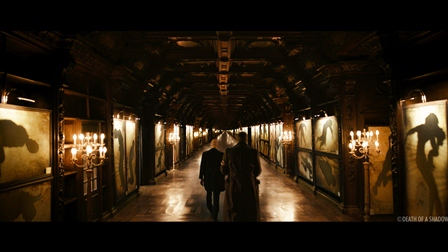
"Death of a Shadow" - An unsettling, original steampunk/supernatural love story. A dead soldier wants desperately to return to his life and find out about a mysterious woman who helped him just before he was killed. He has a chance to return to the living world if he can pay off a 10,000 person debt to a creepy, James Carville-esque afterworld entity who deals in the captured shadows of the dying. A weird, arty concept that works. It gives you just enough clues to piece it together, but owns its mystery, leaving just a few dangling bits of unanswered intrigue. (Are they intentional plot holes? Distortions or new wrinkles of the "laws" of time-travel? Thought provoking, nonetheless.) The stellar production, expressionistic mood and imagery, and seamless use of CGI elevate this short to the top of the heap, in my opinion.


Tuesday, February 5, 2013

Animated Shorts, & I Don't Mean Enthusiastic Culottes

Finally getting into the groove for Oscar Season, here’s my rundown on the Animated Shorts Category. Of note: all 5 nominees are purely visual works, without a single word of intelligible dialogue.

Maggie Simpson in “The Longest Daycare” - After its start as a short-form bumper during the "Tracey Ullman Show" sparked 23+ Seasons on the telly and one pretty great but snubbed movie, America's quintessential cartoon family has returned to its roots. Thanks to their taciturn toddler taking the reins in their first theatrically-run short, which appeared as a lead-in for Ice Ace: Continental Drift, they have finally nabbed an Oscar Nomination to toss in with their dump truck full of other awards. I chuckled out loud when Maggie’s face appeared in full starburst Disney-esque glory, and the short goes for the heartstrings in the vein of old-school theatrical shorts. It’s quick and cute, and contains lovely little splitquick sight gags, but there's not a whole lot that’s new to fans of the show. The Ayn Rand School for Tots debuted in the classic “A Streetcar Named Marge” episode, which delivered a much more hilarious spoof of The Great Escape and The Birds

Paperman - Frankly, this was my least favorite of the nominated quintet. A Disney produced, overly sentimental Brief Encounter story with a few chuckles, which has an Adrien Brody-esque schlub trying desperately to get the attention of a mute Princess Ariel by, well, throwing things at her. I couldn’t get past a conceit ripped straight from The Sorcerer's Apprentice and Brazil (spoiler!) and the unsettling thought that someone thought it would be tasteful to have a man repeatedly throwing airplanes at a New York skyscraper (paper airplanes, sure, but airplanes nonetheless). Maybe I’m being touchy or cynical, but it rubbed me the wrong way. The animation uses a clean black and white pencil quality with a few crayon-on-paper splashes of color (Schindler’s List, hmmm?), but it’s still very much idiosyncratically classic Diz.

(Edit: Unsurprisingly, Diz already shot down the youtube of the full short, so here's a pretty cool little behind the scenes with the making-of technology. I'm not denying these guys are doing interesting stuff, just didn't pay off with me in the end result.)


Head Over Heels - A touching metaphor for the turbulent distance grown between husband and wife, who occupy opposite sides of a house spinning through space; one lives on the ceiling and the other on the floor. (Or vice versa, depending on your perspective.) I felt like it grew past the great idea of its smart, dizzying defiance of physics and got a little off track and overly mawkish. The ending ties things together, but its through-line is rather unfocused.


Fresh Guacamole - A follow up to PES’s excellent "Western Spaghetti", this walks in the same footsteps but pays off better. It is light at only 2 minutes, something that would fit as a bumper in an episode of “Sesame Street” or “Pinwheel.” Outstanding and worth a watch, but not worth the time it would take to describe it when you can see for yourself here:


Adam and Dog - A gorgeous Genesis story following a wild mutt who meets man for the first time, establishing that the friendship between man and his “best friend” is one that is truly primal and has stood the test of time. The highlight here is the lush use of background land- and skyscapes, painted in overwhelming swaths of color that range from impressionism to expressionism. It’s a throwback to hand-drawn, hand-painted animation, and the small animated figures have instant personality, even from a distance, and frolic engulfed in the scenery of Eden. The contrast then makes the first couple’s exile from the garden all the more harsh and striking. I can look past the fact that Adam looked like a character straight from “For Better or for Worse,” this really shined on the big screen and gets my nod. Trailer only.

Review of the Live Action Shorts nominees coming soon!

Saturday, February 2, 2013

I Blogged a Blog of Flicks Gone By

I've kicked off 2013 with plenty of movie watching -- 26 films in January -- but not much blogging so far. Deservedly, I have been getting grief for lack of posts, in one case simply because the poster for Bad Taste keeps popping up as the flipboard image. So, for Greg, here's a picture of a kitteh:

http://filmmakeriq.com/2013/01/les-meowserables/
A good portion of my movie month was consumed with watching and discussing various adaptations of Victor Hugo's novel. It's unfortunate I don't have a streaming live audio feed of my numerous libation-fueled rants to plug directly into the blog. Maybe someone with more tech prowess than I can show me how to do that. Although, on second thought, the background yelling would probably render that unlistenable.

Full confession, although I played highlights from The Miserables: The Musical in high school band I have not seen the full stage show. For a while I was convinced the entire show was fabricated as elaborate faux-celebratory special for PBS to air during pledge drives and that a full show never really existed. Ok, I was wrong.

The novel itself is a daunting tome so if I was going to familiarize myself with the story I needed to do some research. Luckily, I tracked down a copy of one of the first filmed adaptations of the novel, a French version directed by Raymond Bernard in 1933-34 -- It was released under Criterion's Eclipse sub-label, before that it was hard to find. Until I have a year to sit down and read the novel I can't directly attest to Bernard's unwavering faithfulness to the source material, but I can asssure you that this is the version to see. For full disclosure, I recognize the possible cons in recommending this to others: (1) it's in French with subtitles which will (ironically) make some people turn up their noses like a snooty Frenchman; and (2) it runs just short of 5 hours. The length and pacing are crucial, though, and it is split into 3 distinct sections so it plays like miniseries.

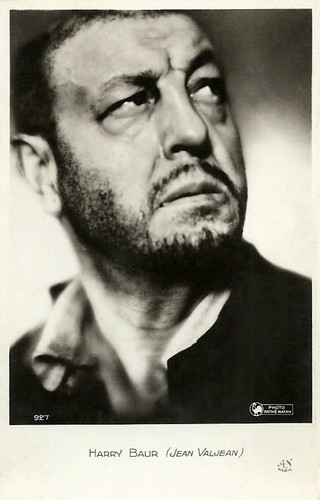
Most importantly, Harry Baur is the Jean Valjean. He has the hulking size and look to be believable as criminal who could win a World's Strongest Man competition -- no offense to Wolverine -- and he has the acting chops to handle the delicate scenes with amazing tenderness.


He also plays Champmathieu with great hammy aplomb, showing range in a "twin" role that Haley Mills never managed. (As an aside into real life, Baur was arrested and tortured by the Gestapo during WWII. I suspect they never saw this scene. He was eventually released but, sadly, died a few days later.)

The Bernard version benefits from his subtle direction and visual style full of quaintly skewed angles. Baur is the main attraction, but he is aided by colorful performances by the entire cast, notably an extremely complex, dastardly but almost compassionate Javert (Charles Vanel), truly despicable Thénardiers (avec Charles Dulle et Marguerite Moreno) and the most impish Gavroche imaginable (Émile Genevois). Ultimately, I really felt moved by the breadth and depth of the film, the themes of redemption and forgiveness, the mixture of tragedy and triumph. It is nothing short of a masterpiece, a feeling that was reinforced by viewings of subsequent adaptations.

I quickly forged ahead, taking in two early Hollywood adaptations (see below) before tackling the recent "Glee"-ification of the story. My feeling of the Tom Hooper 2012 effort is generally positive, but there were some foibles. Much has already been said and written about the mixed response to its live-singing/acting experiment, and I agree that the results ranged from exceptional (Anne Hathaway and Samantha Barks) to adequate (Hugh Jackman) to excruciating (Russell Crowe and Eddie Redmayne). While I have been informed that "I Dreamed a Dream" was shifted from after Fantine's firing until later in her life's downward spiral, which upset some people, it has such raw emotional resonance that it is hands-down one of the most memorable scenes of the film year. I think the lady behind me was still crying about it 20 minutes later. (This is not hyperbole. I almost pulled one of these.)

Rowr.
Eponine's unrequited-love storyline is also a favorite of mine, and Samantha Barks is truly heartbreaking. (Also pretty smokin'.) The beauty and scope of the cinematography was breathtaking at times, but often hampered by some overused sweeps of CGI, headache-inducing handheld work, and small technical oddities and oversights, such as few stray out-of-focus close-ups. Adding to the distraction were accents that shift from French to British to Australian, probably not very common during the French Revolution. They squeeze all of the songs in and even wrote a new one for the movie, but as it runs overlong and the pacing drags they probably could have tightened things up by excising "Suddenly" and trimming a few others. (I know, I know...but it sounds as though purists are upset anyway.) All in all, a pretty solid experience, but not without its faults.


So, to recap and score the versions I've seen
#1 - dir. Raymond Bernard (1933/34) 98

...(look down)

...(look down)

#2 - dir. Tom Hooper (2012) 69

#3 - dir. Richard Boleslawski (1935) 65
Points for Charles Laughton as Javert, but I've never been much of a fan of Fredric March (Valjean) and they inserted some bad storylines, like sending Valjean to the be a galley slave while Javert cracks the whip. Depression-era themes fit with the story, but get sledgehammered home without subtlety.

#4 - dir. Lewis Milestone (1952) 50
Basically a remake of the 1935 script, with all of its inherent faults and even worse dialogue. Michael Rennie and Robert Newton make a fairly insufferable pair as Valjean and Javert, and things start to get muddy fast after the scene with the bishop (the always-great Edmund Gwenn): they turn Valjean into a potter, Thénardiers are excised altogether, and (spoiler!) Fantine gets to see Cosette before she dies! Ugh. No. Just...no.

There are about a half-dozen more versions that I eventually need to check out. I just found TIME's top 10 list of Les Miz adaptations and am happy to see they generally agree with my assessment, placing Bernard's work at the top of the heap. Vindication!

Oh, wait. I almost forgot about a version that easily takes over the #2 spot:


Excellent. "Bitten in Zee Butt" is now stuck in my head. And damn, Bernadette Peters is amazing on so many levels. That's all, folks!

Sunday, December 9, 2012

I Has a Blerg. What a Dump.

Catching up the last month. Hey, better than nothing.

The Master (2012, Paul Thomas Anderson) 85
Stellar work from Amy Adams and Philip Seymour Hoffman, and an utterly raw, animalistic volcano of a performance from Joaquin Phoenix, channelling the best of Brando and De Niro, puts him on the Oscar shortlist. A tough, enigmatic piece from Paul Thomas Anderson, with large, glowing cinematography that elevates the overall picture from a "really good" small-screen pic to a "really great" large-screen one.

Blue Sunshine (1978, Jeff Lieberman) 70
10 years after a group of college friends tried a bad batch of LSD they start feeling the aftereffects, namely a spate of mindless zombie-like killing, in this cheesy, culty piece of drug/zombie paranoia that dropped before the rise of the slasher film. You could almost say this is the anti-Big Chill. Loads of fun.

The Friends of Eddie Coyle (1973, Peter Yates) 90
Always great to dig up a lesser-known crime classic. This one, from the director of the ultracool Bullitt,
ranks with Robert Mitchum's finest performances, right up there with Night of the Hunter, Cape Fear, and Out of the Past. Watchable, re-watchable, memorizable, and so good it hurts like a bastard.


The Fog of War: Eleven Lessons from the Life of Robert S. McNamara (2003) 88
Mr. Death: The Rise and Fall of Fred A. Leuchter, Jr. (1999) 70
Director Errol Morris provided two very different portraits of two very different men, but both films are stamped with his deep-probing documentary style. The Fog of War is perhaps the pinnacle of his career, gleaning surprising insight from an all-time irascible interviewee into many of the most pivotal moments of the 20th Century, including but not limited to the bombing of Japan, the Bay of Pigs Invasion, the Cuban Missile Crisis, and the Gulf of Tonkin Incident. Mr. Death is also engrossing with an oddly egotistical subject, a man who gained success designing execution machines and selling them to various states for use on Death Row, but brought more notoriety by positing as an "expert" and becoming one of the most important Holocaust deniers in the movement.

Paradise Lost 3: Purgatory (2011, Joe Berlinger & Bruce Sinofsky) 82
Another on the doc front, the final piece (for now) of a truly remarkable story 20 years in the making that is important on so many levels. The trilogy is a testament to the evolution of the documentary format, the failures and frustrations of police and legal procedure, and a testament to indefatigable spirit in the face of overwhelming adversity.

Pulp Fiction (1994, Dir. Quentin Tarantino) 100
Okay, this was at least my tenth viewing of this, and it never looked better than in HD after a bunch of cocktails. I wanted to recommend the next time you watch it take note of all of the times food is mentioned. Made me hungry for a Durward Kirby burger, bloody as hell, of course.

A Dangerous Method (2011, David Cronenberg) 64
I've seen just about everything Cronenberg's done, yes including the oddball of his career Fast Company, and sad to say this is one of his weaker efforts. Kiera Knightly's perf is hit-and-miss, the excellent raw physicality mostly ruined by a distracting, mediocre accent. Not enough happening here to fully pull me in.

Bad Taste (1987, Peter Jackson) 87
Jackson's wild debut feature packs a lot of punch up its low-budget sleeves, with amazing, gory makeup and special effects holding up a hilariously wild story about a team of bizarre Kiwis saving  Earth from an alien takeover. He's made a mint with the Tolkien stuff, but he should also be remembered for the unique, twisted start of his career with this, Dead Alive, and Heavenly Creatures. An all-time great movie poster as well. >>

The Amazing Spider-Man (2012, Marc Webb) 74
Maybe the terrrrrrrible third part of Sam Raimi's installment left a >> in my mouth. Or maybe I just really like Emma Stone that much more than Kirsten Dunst. For whatever reason, I enjoyed this quite a bit. Great FX. Good supporting cast. Over-the-top baddie and ending.

Melancholia (2011, Lars von Trier) 82
Speaking of Kirsten Dunst...yeah, not a huge fan, but well, at least she has a glowingly framed nude scene in this one. The rest of the film is weirdly gorgeous on the eyes, with lots and lots of unresolved Tristan chords. It's also brutally depressing in line with a lot of von Trier's oeuvre, and maybe not a good suggestion for anyone worried that Earth is truly reaching her last days.


That catches up some stuff for now. I also spent a little time working on Season 4 of "Breaking Bad" and Season 2 of "The Walking Dead" (not fully caught up on either, yet, unfortunately), and then I started a week of James Bond from the get-go, from Dr. No through On Her Majesty's Secret Service, including a quick detour at Casino Royale (the 1967 spoof). I'm frozen on the Bond-a-thon until I either get my hands on a digital copy of Diamonds are Forever or finally get around to hooking up my VCR to a monitor.

Monday, November 5, 2012

The End of the Trail. (Thank heavens!)

Election Day is at hand, which means it's also time for me to wrap up this ultimately half-cocked scheme for October. I know you're all sick of the flyers and the robo-calls. Here's my last gasp at throwing some great political films your way. Better late than never, but once this election's over you can bet your ass that the next 4 years are going to be one long campaign cycle anyway. Might as well dig in and study up.

John Adams (2008) Dir: Tom Hooper

Maybe it was too drastic an undertaking for my own good this month, but I hunkered down with the 7-part John Adams miniseries over the course of a week or so. I'm glad I did, though. It's a really great achievement, with wonderful performances all around, especially Paul Giamatti as the titular 2nd President, and Laura Linney as his wife Abigail, who provided an incredibly strong rock upon which to anchor his ship. Also, through taking its adaptation from David McCullough's book, the series strips away the legends and provides a grounding sense of humanity to many of our founding fathers, notably Tom Wilkinson lending a delicious salaciousness to Benjamin Franklin. George Washington, however, is still exhibited as having a godlike air of quiet strength. Adams' political battles with Thomas Jefferson and Alexander Hamilton provide nerdy yet gripping historical fodder.

It makes me wonder how wonderful it would be, how much more productive government could become, if we reverted to the voting system that gave the Vice Presidency to the runner up of the election, rather than having a chosen running mate. Although the power of the Vice President is fairly minimal, he does preside over the Senate, and could be an interesting balance to a President from the other party. Interestingly enough, there is talk during this election that in the event of an Electoral College tie (269 votes each) that a vote of the House of Representative would choose the President and the Senate would choose the Vice-President. Since Congress is currently split we could see a POTUS/Veep situation not all too dissimilar from way things were before the Twelfth Amendment was passed in 1800.

Tanner '88 (1988) Dir: Robert Altman

 Continuing with another mini-series, "Tanner '88" is still a must-see and as sharply relevant now as it was 25 years ago. In what would be a part of HBO's burgeoning original programming scene, Co-creators director Robert Altman and writer Garry Trudeau hatched the idea of running a fake candidate with a full-on fake campaign out into the very real 1988 election season. Watching Michael Murphy as candidate Jack Tanner and his staff, headed up by a very game Pamela Reed as his campaign chief, interact at rallies and conventions with the oblivious real politicians (Al Gore, Jesse Jackson, Michael Dukakis, etc.) and an easily fooled electorate delivers 11 episodes of smart, biting humor and an unparalleled insight behind the facade of political barnstorming. Altman had touched on the circus exuberance of political campaigns in his landmark 1976 film, Nashville, but in "Tanner '88" it is the star of the show. Satire is rarely this perfectly thought out or divinely delivered.

The War Room (1993) Dir: Chris Hegedus & D.A. Pennebaker

On the boot heels of "Tanner '88," this documentary peeks inside an actual campaign, in this case Bill Clinton's successful bid at the Presidency in 1992. This strips away the satire and goes for the gritty, unvarnished weariness of the campaign headquarters. James Carville and George Stephanopoulos would soon become household names, and this shows them in all of their spin-doctoring glory, though we are unfortunately withheld from some of the juicier conversations due to the lack of participation of campaign manager David Wilhelm. A bit slow at times, but a good dry chaser of reality to wash down Tanner's shenanigans.

Point of Order (1964) Dir: Emile de Antonio

The Army-McCarthy hearings were the grandfather of all televised Congressional Procedural, and this is a culling of approximately 90 minutes of the most dramatic moments from 30 days worth of ABC footage that was broadcast live into every home in America and precipitated the downfall of Joseph McCarthy's communist witch hunts. It remains a landmark document, not just of an important era of Cold-War Politics, but also portends the of the role television media in the perception of our elected officials. Through discussions of cropped photos and legal favors the banter between Army counsel Joseph Welch and McCarthy is affable and at moments outright hilarious, but the breaking of a gentleman's agreement turns things vicious, until Welch's plaintive plea for decency crushes all remaining credibility from the boorish Senator from Wisconsin and remains a legendary part of our lexicon:


All the King's Men (1948) Dir: Robert Rossen

and Huey Long (1985) Dir: Ken Burns

I'll admit that I don't read recreationally as much a I wish I did. I have a pretty good collection of classic books on my shelves (or at least, I would if I still had shelves) that I have picked up second hand for pennies. But I've only really read maybe 20% of what I have. At one point I was in a book/beer club, but some of the members couldn't be bothered to do the work and it faltered.

One of the classic American novels that I have read and highly recommend is Robert Penn Warren's All the King's Men, a thinly veiled account of the rise and fall of Louisiana governor "populist/dictator" Huey Long. The 1949 film the movie brings the novel to life wonderfully,  skimping a bit on some of the richness of reporter/narrator Jack Burden's unrequited love (which is actually my favorite section of the book; the words are beautifully heartbreaking, the melancholy of missed opportunity, the admitted shortcomings and the wordy yet perfectly natural flow of the prose.) I've been purposely avoiding the 2006 film revision for a while now after hearing it is rather subpar. I may check it out, but in terms of recs I'd suggest sticking with the Oscar winner.

Ken Burns' made-for-TV biography "Huey Long," however, is the perfect accompanying third to this book/film pairing. In fact, I would encourage a viewing of it before tackling any screen or page version of All the King's Men. It provides a fascinating history lesson on a political figure who is mostly passed up or completely forgotten about nowadays. Long was easily one of the 5 most powerful men in the world during his era of bombastic (and this was during a moment when Adolf Hitler was coming to power in Germany) but nowadays The Kingfish is largely forgotten in popular history. Utilizing first person accounts of people who were young during the 1930s and witnessed Long's powerful sway, it sheds a light on a truly polarizing figure, as scorned by many as he was adored by the rest.

We are also exhibited with the prototype of a Ken Burns style that would carry through his essential (but loooong) "Jazz" and "Baseball" docs. "Huey Long," on the other hand, is very focused, clocking in under 90 minutes.


In closing, there are obviously a ton of war films that could have fallen into this category (All Quiet on the Western Front, Paths of Glory, Flags of Our Fathers, Saving Private Ryan, Patton, and on for hours), and some that revolve more loosely around political campaigns (Nashville, Taxi Driver, etc.) but I didn't quite as much time as I wanted. I'm intrigued by Spielberg's upcoming Lincoln only because of Daniel Day Lewis. I have a feeling it's going to be pretty crappy though. More importantly, I don't want to leave things without mentioning that there are some astounding political international films as well:  I highly recommend Memories of Underdevelopment (Cuba), Z (Greece), Battle of Algiers (Italy/Algeria), and Persepolis (Iran) just to name a few. Next on my docket is The Battle of Chile (er...right after I catch up with "Breaking Bad.") As for tomorrow, like a lot of you I'll be going out early to vote, then after work I'll be watching the news with mild interest.

Friday, November 2, 2012

'K, Martyrs...That's Enough.

Halloween night I chose to forgo the dress up and candy pander in favor of a doubleheader in front of a glowing screen. My first movie was Pascal Laugier's Martyrs, a French/Canadian production that I'd heard it was pretty intense, most commonly summed up with the caveat "torture porn." When I hear that I'm thinking violence along the lines of Se7en, Saw, or Gaspar Noé's incredible but often tough to stomach Irréversible. I've seen Pasolini's notorious Saló, or the 120 Days of Sodom, so I'm pretty doughty when the shit goes down, so to speak. But I wasn't really prepared for an entire film that is a nonstop, paralyzingly on-edge gut-check whose tamest moments make the harshest parts in The Girl with the Dragon Tattoo seem like a tea party in Care-a-Lot with Strawberry Shortcake and the My Little Ponies. After I finished I was in no state of mind to finish the double feature.

Scott Tobias of AV Club does a great job unfurling the plot if curiosity compels you to wonder what the BFD is, so I won't rehash it here. It is extremely taxing and not one that I would casually recommend or be in a hurry to watch again, but it is also a very good, well made and inciting movie, provoking thoughtful debate, especially with its open-to-interpretation ending that I'm still mulling over 2 days later. I just wanted to put down for posterity that I indeed finished it in one undeterred sitting and remarking on it felt like a good way to culminate an October spent almost exclusively watching horror/monster movies. After Martyrs, I am left with the ultimate takeaway of the month that once we are reminded that humans can be the worst monsters imaginable, then every other thing we can fathom is a lot less scary.  

Speaking of scary: one or two final splashes of political films are on tap for this pre-election weekend. Hope everybody takes some time to study up on their ballots and make good informed selections this Tuesday.