Saturday, February 2, 2013

I Blogged a Blog of Flicks Gone By

I've kicked off 2013 with plenty of movie watching -- 26 films in January -- but not much blogging so far. Deservedly, I have been getting grief for lack of posts, in one case simply because the poster for Bad Taste keeps popping up as the flipboard image. So, for Greg, here's a picture of a kitteh:

http://filmmakeriq.com/2013/01/les-meowserables/
A good portion of my movie month was consumed with watching and discussing various adaptations of Victor Hugo's novel. It's unfortunate I don't have a streaming live audio feed of my numerous libation-fueled rants to plug directly into the blog. Maybe someone with more tech prowess than I can show me how to do that. Although, on second thought, the background yelling would probably render that unlistenable.

Full confession, although I played highlights from The Miserables: The Musical in high school band I have not seen the full stage show. For a while I was convinced the entire show was fabricated as elaborate faux-celebratory special for PBS to air during pledge drives and that a full show never really existed. Ok, I was wrong.

The novel itself is a daunting tome so if I was going to familiarize myself with the story I needed to do some research. Luckily, I tracked down a copy of one of the first filmed adaptations of the novel, a French version directed by Raymond Bernard in 1933-34 -- It was released under Criterion's Eclipse sub-label, before that it was hard to find. Until I have a year to sit down and read the novel I can't directly attest to Bernard's unwavering faithfulness to the source material, but I can asssure you that this is the version to see. For full disclosure, I recognize the possible cons in recommending this to others: (1) it's in French with subtitles which will (ironically) make some people turn up their noses like a snooty Frenchman; and (2) it runs just short of 5 hours. The length and pacing are crucial, though, and it is split into 3 distinct sections so it plays like miniseries.

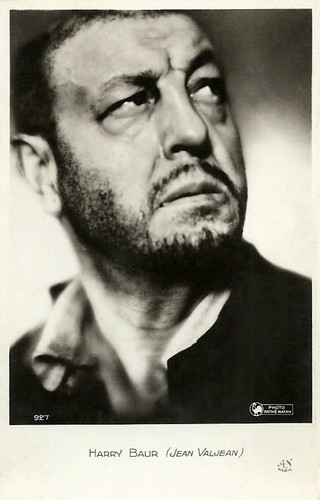
Most importantly, Harry Baur is the Jean Valjean. He has the hulking size and look to be believable as criminal who could win a World's Strongest Man competition -- no offense to Wolverine -- and he has the acting chops to handle the delicate scenes with amazing tenderness.


He also plays Champmathieu with great hammy aplomb, showing range in a "twin" role that Haley Mills never managed. (As an aside into real life, Baur was arrested and tortured by the Gestapo during WWII. I suspect they never saw this scene. He was eventually released but, sadly, died a few days later.)

The Bernard version benefits from his subtle direction and visual style full of quaintly skewed angles. Baur is the main attraction, but he is aided by colorful performances by the entire cast, notably an extremely complex, dastardly but almost compassionate Javert (Charles Vanel), truly despicable Thénardiers (avec Charles Dulle et Marguerite Moreno) and the most impish Gavroche imaginable (Émile Genevois). Ultimately, I really felt moved by the breadth and depth of the film, the themes of redemption and forgiveness, the mixture of tragedy and triumph. It is nothing short of a masterpiece, a feeling that was reinforced by viewings of subsequent adaptations.

I quickly forged ahead, taking in two early Hollywood adaptations (see below) before tackling the recent "Glee"-ification of the story. My feeling of the Tom Hooper 2012 effort is generally positive, but there were some foibles. Much has already been said and written about the mixed response to its live-singing/acting experiment, and I agree that the results ranged from exceptional (Anne Hathaway and Samantha Barks) to adequate (Hugh Jackman) to excruciating (Russell Crowe and Eddie Redmayne). While I have been informed that "I Dreamed a Dream" was shifted from after Fantine's firing until later in her life's downward spiral, which upset some people, it has such raw emotional resonance that it is hands-down one of the most memorable scenes of the film year. I think the lady behind me was still crying about it 20 minutes later. (This is not hyperbole. I almost pulled one of these.)

Rowr.
Eponine's unrequited-love storyline is also a favorite of mine, and Samantha Barks is truly heartbreaking. (Also pretty smokin'.) The beauty and scope of the cinematography was breathtaking at times, but often hampered by some overused sweeps of CGI, headache-inducing handheld work, and small technical oddities and oversights, such as few stray out-of-focus close-ups. Adding to the distraction were accents that shift from French to British to Australian, probably not very common during the French Revolution. They squeeze all of the songs in and even wrote a new one for the movie, but as it runs overlong and the pacing drags they probably could have tightened things up by excising "Suddenly" and trimming a few others. (I know, I know...but it sounds as though purists are upset anyway.) All in all, a pretty solid experience, but not without its faults.


So, to recap and score the versions I've seen
#1 - dir. Raymond Bernard (1933/34) 98

...(look down)

...(look down)

#2 - dir. Tom Hooper (2012) 69

#3 - dir. Richard Boleslawski (1935) 65
Points for Charles Laughton as Javert, but I've never been much of a fan of Fredric March (Valjean) and they inserted some bad storylines, like sending Valjean to the be a galley slave while Javert cracks the whip. Depression-era themes fit with the story, but get sledgehammered home without subtlety.

#4 - dir. Lewis Milestone (1952) 50
Basically a remake of the 1935 script, with all of its inherent faults and even worse dialogue. Michael Rennie and Robert Newton make a fairly insufferable pair as Valjean and Javert, and things start to get muddy fast after the scene with the bishop (the always-great Edmund Gwenn): they turn Valjean into a potter, Thénardiers are excised altogether, and (spoiler!) Fantine gets to see Cosette before she dies! Ugh. No. Just...no.

There are about a half-dozen more versions that I eventually need to check out. I just found TIME's top 10 list of Les Miz adaptations and am happy to see they generally agree with my assessment, placing Bernard's work at the top of the heap. Vindication!

Oh, wait. I almost forgot about a version that easily takes over the #2 spot:


Excellent. "Bitten in Zee Butt" is now stuck in my head. And damn, Bernadette Peters is amazing on so many levels. That's all, folks!

Sunday, December 9, 2012

I Has a Blerg. What a Dump.

Catching up the last month. Hey, better than nothing.

The Master (2012, Paul Thomas Anderson) 85
Stellar work from Amy Adams and Philip Seymour Hoffman, and an utterly raw, animalistic volcano of a performance from Joaquin Phoenix, channelling the best of Brando and De Niro, puts him on the Oscar shortlist. A tough, enigmatic piece from Paul Thomas Anderson, with large, glowing cinematography that elevates the overall picture from a "really good" small-screen pic to a "really great" large-screen one.

Blue Sunshine (1978, Jeff Lieberman) 70
10 years after a group of college friends tried a bad batch of LSD they start feeling the aftereffects, namely a spate of mindless zombie-like killing, in this cheesy, culty piece of drug/zombie paranoia that dropped before the rise of the slasher film. You could almost say this is the anti-Big Chill. Loads of fun.

The Friends of Eddie Coyle (1973, Peter Yates) 90
Always great to dig up a lesser-known crime classic. This one, from the director of the ultracool Bullitt,
ranks with Robert Mitchum's finest performances, right up there with Night of the Hunter, Cape Fear, and Out of the Past. Watchable, re-watchable, memorizable, and so good it hurts like a bastard.


The Fog of War: Eleven Lessons from the Life of Robert S. McNamara (2003) 88
Mr. Death: The Rise and Fall of Fred A. Leuchter, Jr. (1999) 70
Director Errol Morris provided two very different portraits of two very different men, but both films are stamped with his deep-probing documentary style. The Fog of War is perhaps the pinnacle of his career, gleaning surprising insight from an all-time irascible interviewee into many of the most pivotal moments of the 20th Century, including but not limited to the bombing of Japan, the Bay of Pigs Invasion, the Cuban Missile Crisis, and the Gulf of Tonkin Incident. Mr. Death is also engrossing with an oddly egotistical subject, a man who gained success designing execution machines and selling them to various states for use on Death Row, but brought more notoriety by positing as an "expert" and becoming one of the most important Holocaust deniers in the movement.

Paradise Lost 3: Purgatory (2011, Joe Berlinger & Bruce Sinofsky) 82
Another on the doc front, the final piece (for now) of a truly remarkable story 20 years in the making that is important on so many levels. The trilogy is a testament to the evolution of the documentary format, the failures and frustrations of police and legal procedure, and a testament to indefatigable spirit in the face of overwhelming adversity.

Pulp Fiction (1994, Dir. Quentin Tarantino) 100
Okay, this was at least my tenth viewing of this, and it never looked better than in HD after a bunch of cocktails. I wanted to recommend the next time you watch it take note of all of the times food is mentioned. Made me hungry for a Durward Kirby burger, bloody as hell, of course.

A Dangerous Method (2011, David Cronenberg) 64
I've seen just about everything Cronenberg's done, yes including the oddball of his career Fast Company, and sad to say this is one of his weaker efforts. Kiera Knightly's perf is hit-and-miss, the excellent raw physicality mostly ruined by a distracting, mediocre accent. Not enough happening here to fully pull me in.

Bad Taste (1987, Peter Jackson) 87
Jackson's wild debut feature packs a lot of punch up its low-budget sleeves, with amazing, gory makeup and special effects holding up a hilariously wild story about a team of bizarre Kiwis saving  Earth from an alien takeover. He's made a mint with the Tolkien stuff, but he should also be remembered for the unique, twisted start of his career with this, Dead Alive, and Heavenly Creatures. An all-time great movie poster as well. >>

The Amazing Spider-Man (2012, Marc Webb) 74
Maybe the terrrrrrrible third part of Sam Raimi's installment left a >> in my mouth. Or maybe I just really like Emma Stone that much more than Kirsten Dunst. For whatever reason, I enjoyed this quite a bit. Great FX. Good supporting cast. Over-the-top baddie and ending.

Melancholia (2011, Lars von Trier) 82
Speaking of Kirsten Dunst...yeah, not a huge fan, but well, at least she has a glowingly framed nude scene in this one. The rest of the film is weirdly gorgeous on the eyes, with lots and lots of unresolved Tristan chords. It's also brutally depressing in line with a lot of von Trier's oeuvre, and maybe not a good suggestion for anyone worried that Earth is truly reaching her last days.


That catches up some stuff for now. I also spent a little time working on Season 4 of "Breaking Bad" and Season 2 of "The Walking Dead" (not fully caught up on either, yet, unfortunately), and then I started a week of James Bond from the get-go, from Dr. No through On Her Majesty's Secret Service, including a quick detour at Casino Royale (the 1967 spoof). I'm frozen on the Bond-a-thon until I either get my hands on a digital copy of Diamonds are Forever or finally get around to hooking up my VCR to a monitor.

Monday, November 5, 2012

The End of the Trail. (Thank heavens!)

Election Day is at hand, which means it's also time for me to wrap up this ultimately half-cocked scheme for October. I know you're all sick of the flyers and the robo-calls. Here's my last gasp at throwing some great political films your way. Better late than never, but once this election's over you can bet your ass that the next 4 years are going to be one long campaign cycle anyway. Might as well dig in and study up.

John Adams (2008) Dir: Tom Hooper

Maybe it was too drastic an undertaking for my own good this month, but I hunkered down with the 7-part John Adams miniseries over the course of a week or so. I'm glad I did, though. It's a really great achievement, with wonderful performances all around, especially Paul Giamatti as the titular 2nd President, and Laura Linney as his wife Abigail, who provided an incredibly strong rock upon which to anchor his ship. Also, through taking its adaptation from David McCullough's book, the series strips away the legends and provides a grounding sense of humanity to many of our founding fathers, notably Tom Wilkinson lending a delicious salaciousness to Benjamin Franklin. George Washington, however, is still exhibited as having a godlike air of quiet strength. Adams' political battles with Thomas Jefferson and Alexander Hamilton provide nerdy yet gripping historical fodder.

It makes me wonder how wonderful it would be, how much more productive government could become, if we reverted to the voting system that gave the Vice Presidency to the runner up of the election, rather than having a chosen running mate. Although the power of the Vice President is fairly minimal, he does preside over the Senate, and could be an interesting balance to a President from the other party. Interestingly enough, there is talk during this election that in the event of an Electoral College tie (269 votes each) that a vote of the House of Representative would choose the President and the Senate would choose the Vice-President. Since Congress is currently split we could see a POTUS/Veep situation not all too dissimilar from way things were before the Twelfth Amendment was passed in 1800.

Tanner '88 (1988) Dir: Robert Altman

 Continuing with another mini-series, "Tanner '88" is still a must-see and as sharply relevant now as it was 25 years ago. In what would be a part of HBO's burgeoning original programming scene, Co-creators director Robert Altman and writer Garry Trudeau hatched the idea of running a fake candidate with a full-on fake campaign out into the very real 1988 election season. Watching Michael Murphy as candidate Jack Tanner and his staff, headed up by a very game Pamela Reed as his campaign chief, interact at rallies and conventions with the oblivious real politicians (Al Gore, Jesse Jackson, Michael Dukakis, etc.) and an easily fooled electorate delivers 11 episodes of smart, biting humor and an unparalleled insight behind the facade of political barnstorming. Altman had touched on the circus exuberance of political campaigns in his landmark 1976 film, Nashville, but in "Tanner '88" it is the star of the show. Satire is rarely this perfectly thought out or divinely delivered.

The War Room (1993) Dir: Chris Hegedus & D.A. Pennebaker

On the boot heels of "Tanner '88," this documentary peeks inside an actual campaign, in this case Bill Clinton's successful bid at the Presidency in 1992. This strips away the satire and goes for the gritty, unvarnished weariness of the campaign headquarters. James Carville and George Stephanopoulos would soon become household names, and this shows them in all of their spin-doctoring glory, though we are unfortunately withheld from some of the juicier conversations due to the lack of participation of campaign manager David Wilhelm. A bit slow at times, but a good dry chaser of reality to wash down Tanner's shenanigans.

Point of Order (1964) Dir: Emile de Antonio

The Army-McCarthy hearings were the grandfather of all televised Congressional Procedural, and this is a culling of approximately 90 minutes of the most dramatic moments from 30 days worth of ABC footage that was broadcast live into every home in America and precipitated the downfall of Joseph McCarthy's communist witch hunts. It remains a landmark document, not just of an important era of Cold-War Politics, but also portends the of the role television media in the perception of our elected officials. Through discussions of cropped photos and legal favors the banter between Army counsel Joseph Welch and McCarthy is affable and at moments outright hilarious, but the breaking of a gentleman's agreement turns things vicious, until Welch's plaintive plea for decency crushes all remaining credibility from the boorish Senator from Wisconsin and remains a legendary part of our lexicon:


All the King's Men (1948) Dir: Robert Rossen

and Huey Long (1985) Dir: Ken Burns

I'll admit that I don't read recreationally as much a I wish I did. I have a pretty good collection of classic books on my shelves (or at least, I would if I still had shelves) that I have picked up second hand for pennies. But I've only really read maybe 20% of what I have. At one point I was in a book/beer club, but some of the members couldn't be bothered to do the work and it faltered.

One of the classic American novels that I have read and highly recommend is Robert Penn Warren's All the King's Men, a thinly veiled account of the rise and fall of Louisiana governor "populist/dictator" Huey Long. The 1949 film the movie brings the novel to life wonderfully,  skimping a bit on some of the richness of reporter/narrator Jack Burden's unrequited love (which is actually my favorite section of the book; the words are beautifully heartbreaking, the melancholy of missed opportunity, the admitted shortcomings and the wordy yet perfectly natural flow of the prose.) I've been purposely avoiding the 2006 film revision for a while now after hearing it is rather subpar. I may check it out, but in terms of recs I'd suggest sticking with the Oscar winner.

Ken Burns' made-for-TV biography "Huey Long," however, is the perfect accompanying third to this book/film pairing. In fact, I would encourage a viewing of it before tackling any screen or page version of All the King's Men. It provides a fascinating history lesson on a political figure who is mostly passed up or completely forgotten about nowadays. Long was easily one of the 5 most powerful men in the world during his era of bombastic (and this was during a moment when Adolf Hitler was coming to power in Germany) but nowadays The Kingfish is largely forgotten in popular history. Utilizing first person accounts of people who were young during the 1930s and witnessed Long's powerful sway, it sheds a light on a truly polarizing figure, as scorned by many as he was adored by the rest.

We are also exhibited with the prototype of a Ken Burns style that would carry through his essential (but loooong) "Jazz" and "Baseball" docs. "Huey Long," on the other hand, is very focused, clocking in under 90 minutes.


In closing, there are obviously a ton of war films that could have fallen into this category (All Quiet on the Western Front, Paths of Glory, Flags of Our Fathers, Saving Private Ryan, Patton, and on for hours), and some that revolve more loosely around political campaigns (Nashville, Taxi Driver, etc.) but I didn't quite as much time as I wanted. I'm intrigued by Spielberg's upcoming Lincoln only because of Daniel Day Lewis. I have a feeling it's going to be pretty crappy though. More importantly, I don't want to leave things without mentioning that there are some astounding political international films as well:  I highly recommend Memories of Underdevelopment (Cuba), Z (Greece), Battle of Algiers (Italy/Algeria), and Persepolis (Iran) just to name a few. Next on my docket is The Battle of Chile (er...right after I catch up with "Breaking Bad.") As for tomorrow, like a lot of you I'll be going out early to vote, then after work I'll be watching the news with mild interest.

Friday, November 2, 2012

'K, Martyrs...That's Enough.

Halloween night I chose to forgo the dress up and candy pander in favor of a doubleheader in front of a glowing screen. My first movie was Pascal Laugier's Martyrs, a French/Canadian production that I'd heard it was pretty intense, most commonly summed up with the caveat "torture porn." When I hear that I'm thinking violence along the lines of Se7en, Saw, or Gaspar Noé's incredible but often tough to stomach Irréversible. I've seen Pasolini's notorious Saló, or the 120 Days of Sodom, so I'm pretty doughty when the shit goes down, so to speak. But I wasn't really prepared for an entire film that is a nonstop, paralyzingly on-edge gut-check whose tamest moments make the harshest parts in The Girl with the Dragon Tattoo seem like a tea party in Care-a-Lot with Strawberry Shortcake and the My Little Ponies. After I finished I was in no state of mind to finish the double feature.

Scott Tobias of AV Club does a great job unfurling the plot if curiosity compels you to wonder what the BFD is, so I won't rehash it here. It is extremely taxing and not one that I would casually recommend or be in a hurry to watch again, but it is also a very good, well made and inciting movie, provoking thoughtful debate, especially with its open-to-interpretation ending that I'm still mulling over 2 days later. I just wanted to put down for posterity that I indeed finished it in one undeterred sitting and remarking on it felt like a good way to culminate an October spent almost exclusively watching horror/monster movies. After Martyrs, I am left with the ultimate takeaway of the month that once we are reminded that humans can be the worst monsters imaginable, then every other thing we can fathom is a lot less scary.  

Speaking of scary: one or two final splashes of political films are on tap for this pre-election weekend. Hope everybody takes some time to study up on their ballots and make good informed selections this Tuesday.

Monday, October 29, 2012

Off the Trail and Dead in the Woods.

As I left the house this morning I looked up to see an enormous black crow flying overhead. Then I looked in the backyard and saw this:

Okay, it wasn't quite that, but there was a murder of at least a dozen giant Ann Arbor crows picking apart the remains of a human corpse. Or maybe it was a garbage bag. Either way, There's a storm coming!

With Halloween in 2 days and the election a week away it's time I admit failure in my grand scheme to bounce through October blogging like ghostbusters...er, gangbusters? The distraction of the Detroit Tigers' exciting yet ill-fated run to the World Series is much to blame. Anyway, here's my attempt to quickly shore up the rest of my intent and give you an overview of what I did manage to see, and some of the other films I wanted to write about in depth.

(I did make the effort to check out Paul Thomas Anderson's new one, The Master, but since it's prime Oscar bait and not pertinent to the Halloween theme I'll save that for another time.)

After good luck with Slither and The Host I ran into a stinker with Rubber (Dir. Quentin Dupieux, 2010). I was drawn to the wild plot description about a lone abandoned tire coming to life in the desert, gaining telekinetic powers, and going on a kill crazy rampage. There are some fun parts and cool effects, but the winking self-consciousness of the audience within the movie and the breaking-the-fourth-wall stuff came off extremely stilted, and some scenes drag on for far too long with no forward movement. Ultimately, Rubber blew a flat.

On the other hand, my other random-pickup-and-let's-have-a-looksee was pretty enjoyable. The Eye (Gin gwai) (Dir. by the Pang Brothers, 2002) A blind girl gets a cornea transplant, but as she starts to adjust to having sight she starts having malevolent visions. This one was a lot more enjoyable, with some truly creepy scenes, and a couple of legit jump-out-of-your-seat moments. There is some hokeyness to the doctor/patient love story, and you have to put on your reading glasses, but like so many other great, original Asian nail-biters (Ringu/The Ring, Ju-On/The Grudge) this one underwent a Hollywood remake in 2008 starring Jessica Alba. Just as with those, I can't imagine HW managed to improve on the original.

My favorite film of the month, however, was John Carpenter's They Live (1988). It's a camped-up Invasion of the Body Snatchers starring 80s wrestling superstar "Rowdy" Roddy Piper. He's chewing bubblegum and kickin' butt while uncovering an alien plot to slowly take over the human race through highly sophisticated subliminal conditioning. Thankfully for Earth has a hard-headed sidekick and his trusty Truth-Tellin' Sungees:


That's pretty much it for what I managed to watch this month (probably something on tap the next couple of days, then round up the political stuff by this weekend)

I will round out October by throwing some recs to check out if you're in full Halloween mode.
If you are on the East Coast you should probably NOT watch Take Shelter. Instead, just take shelter.

Here's a great youtube compilation of quotes that will inspire you to find something to watch

Wanna get Dis-Oriented?
In addition to The Host, The Eye, Ringu, etc. there are a slew of other great films from the Far East that are worth a look this week. From Oldboy to Audition, even going back to the mother of all monster movies, Godzilla. If I had to pick one weird one to suggest it would be House (Hausu). Not to be confused with the 1986 Steve Miner horror/comedy of the same name (also pretty great), this one is a really bizarre, almost psychedelic trip from 1977 by director Nobuhiko Obayashi. A group of schoolgirls takes a summer holiday to visit a long lost aunt who may or may not be a witch. But yeah, she totally is. It sets up slowly, but by the time one of the girls is dismembered and swallowed up by a piano you'll be WTF'ing over and over. And never trust cats again (not that your ever should have in the first place).

Speaking of Houses...
Let us not forget some other ominous edifices, from Psycho's gothic house overlooking the Bates Motel to The Amityville Horror house's all-seeing windows, to the lonely dilapidated farmhouse in Texas Chainsaw Massacre. Apartments are no better, as Roman Polanski can brazenly attest: With Repulsion, The Tenant, and Rosemary's Baby, he created a loose, unsettling trilogy that will make you rethink tenancy as a safer option. My favorite haunted house, though, is Hill House from Robert Wise's 1963 classic, The Haunting. With a terrific backstory, and mostly a simple, sinister use of editing, sound effects and chilling music, you'll be on edge as the inevitable dread builds up inside the characters as their sanity slowly disintegrates and the unseen horror advances.

Some Vamps Don't Sparkle
So you've got your Nosferati -- 1922, 1979, 2000 -- and your Draculi -- 1931, 1974 ("The Blood of these whores is killing me!!"), Plus all of the great Hammer horror Dracs, and yeah, even the Bram is worth watching for Oldman. (Keanu...not so much.) As far as I'm concerned, Lost Boys has its fangs in the necks of too many, for around that same time but just around the corner lies Near Dark. Just a fantastic re-imagining of a pack of roaming sangre-suckers, with one of greatest bar fight scenes ever put on celluloid.


Screaming with Laughter
If you want some more camp if not all out laughs, it really doesn't get any better than Young Frankenstein. The Evil Dead Trilogy. And Rocky Horror, of course.  Off the beaten path a bit you've got Re-Animator,  Dead Alive, and a personal childhood fave, Killer Klowns from Outer Space.


And don't forget about Monster Squad! This seems like overkill,  but:


Well put, D.

Monday, October 22, 2012

Deep into the Woods #4 & 5 - Jabberwhat?

Been a bit off track again, lots of Tigers and tailgating and work and whatnot. I'm also rethinking the YouTube thing because I attempted to upload a clip and got a nearly instantaneous notice that it was licensed content (duh) and wouldn't be able to embed. Which is a bummer. I'm doing this for fun and to stretch my brain a bit, so I may go back to mostly screencaps to avoid any trouble. This is a little quick & dirty, thoughts are admittedly a bit random and unorganized,  But hey...content!

Going back to squirmy parts of the horrorsphere. After watching Emanuelle and the Last Cannibals I finished the evening with Slither, one of the better recent alien invasion/horror flicks. Shit goes down when a meteorite touches down in a town that is ultimately a backwoods microcosm, because there's an aggressive, sentient virus-slash-alien on board that only exists to invade, take over (creepily), destroy (disgustingly), and move on. Things happen on a local scale but with possibly widespread ramifications, borrowing ideas from classics like Night of the Living Dead and The Blob. Frankly, it's one if the most ruthless and hard to avoid body-snatching devices since Alien, with one of the most disgusting gestational periods ever. It will give you the urge to step on as many creepy-crawlies as you can see, but it will not do anything to alleviate any pre-established squeamishness.

(Trying the blogger vid here instead, but this may be gone before you know it.)


It manages a whole bevy of new ways to gross us out, with a great building of ingenuity in the devices, there are new "Oh HELL No!" moments around every corner, along with pretty convincing makeup and CGI. Storywise, writer/director James Gunn has tried to inject some heart between Elizabeth Banks' character and her husband, but it's set up that she basically loathes him, he's abusive even before he gets the alien inside him, so the latter stuff comes off as fake. Plus, she's obviously going to end up with Nathan Fillon (assuming they survive). Yeah, I'm overthinking this aspect, I guess. Overall, it's gross, fun, smarmy, even Men in Black-ish absent the glossy toys and forced banter.

___

Later in the week I checked out The Host (Gweomul), the South Korean monster movie sensation. I highly urge people to check this one out. It's a Godzilla tadpole acting like an addict hopped up on Heisenberg meth. The thing comes right out in the daylight in the first 20 minutes, there is nothing to hide. So yeah, I'm clipping it here. Pay special attention to the shot starting at 0:01.30, especially the camera movement.

That is just spectacular choreography and a seamless blend of the real-life and CGI. The creature is noticeably computer-generated, but excellently rendered in great detail and quite a sight to behold. And it has some tricks up its, er, sleeves(?) that surprise us as the show goes on. Yeah, we've come long way from giant, lumbering Gojira to an elephant-sized, lightning-quick, amphibious polliwog with razor sharp fangs and an untrammeled, grasperous monkey tail.

In action-based movies developing character is always difficult and unnatural when you have to develop specific scenes to just to develop character instead of letting it flow organically with the story, and The Host struggles a bit through a long, limp middle section that is only saved by the wonderful scene in the rain (you'll know when you see it) which is the arguably the best scene of the movie -- even better than the scene in the sun clipped above.

It has humorous excursions that are a bit jarring because of slapstick juxtaposed with what one would expect to be a very somber tone, but playing them into satirical moments against political and environmental issues that work for the most part.  Also of note, the architecture of the bridges and sewers around the Han River make for beautiful cinematography, reminding me of Antonioni's obsession with structural edifices, but there is movement here, by the camera, the characters, and the flowing river below, that heightens the composition. It all ends in a grand, atmospheric, dramatic final showdown that is on the verge of being balletic. Worth a serious look.

Sunday, October 7, 2012

On the Trail #3: The Better Way?

Now we truly go on the campaign trail with The Candidate (1972, Dir. Michael Ritchie). Robert Redford is Bill McKay: a young, idealistic, do-goody lawyer who also happens to be handsome AND the son of a former Governor. The National Democratic party decides to  rope him into the California Senate race to face the long-time, impregnable Republican incumbent. McKay is hesitant to embarrass himself and take time away from actually making a difference on the ground, but when Democratic strategist Marvin Lucas (Peter Boyle) gives him free reign to say what he wants, no matter how controversial or unpopular, and assures him that he has no real chance of winning -- in fact, promising him that he will lose -- McKay grudgingly takes the opportunity to stir the pot and try to float some real issues into the political atmosphere.

The faux-documentary filming style gives it a real, gritty feel, with an especially 70s, almost Altman-esque aesthetic: a strong ensemble cast,
overlapping dialogue, with scenes that burst out of the edges of the frame. The major difference is the usage of an inventive editing style that is especially evident in this rather meta clip. It establishes the eventual rift between McKay’s agenda and that of his party handlers, with an emphasis on the cruel, deft cutting of sight and sound in advertising/propaganda.


Also, aaaahh, delicious Hamm’s.
While McKay builds his brand through candor and accessibility, the machine behind him does what they're paid to do: everything in their power to win. Once he is locked in as the candidate after easily winning the Democratic primary, the power of the Party behind him begins to trump his stances through subtle manipulations. Despite lingering familial tension between McKay and his father, the former Governor (Melvyn Douglas) is brought on board to endorse and glad-hand. His marriage, while seemingly blissful, suffers strain underneath the surface; an affair is alluded to but kept out of sight. He eventually begins the long, painful path to selling out, helplessly relenting his neutered principles to the grinding machine and the faint, glowing possibility of victory. His speeches become robotic, his own ideas totally absent, as one stump speech blends meaninglessly into the next. 

 
The Candidate is a witty, absorbing, and deftly constructed. It provides a still-relevant look into the belly of the beast, where it is frustrating to see that, even though the media microscope has definitely enlarged the scale of everything, basic poli-tactics haven't really changed much in the last 40+ years. 
On the heels of the recent real-life debate, I submit one final (extended) scene, an absolute tour de force, replete with recycled issues, oblique answers, and shifting tides, with Redford looking eerily like a young, hippie, Bill Clinton. Study up before the next dog and pony show, people.


The Candidate (1972): 82